
End-to-end architecture
TracePermit is an Agentic Visibility & Control (AVC) proof of concept. Java is the sole supported backend; React provides a read-only console. Every supported simulated side effect is evaluated before simulator execution.
End-to-end architecture diagram
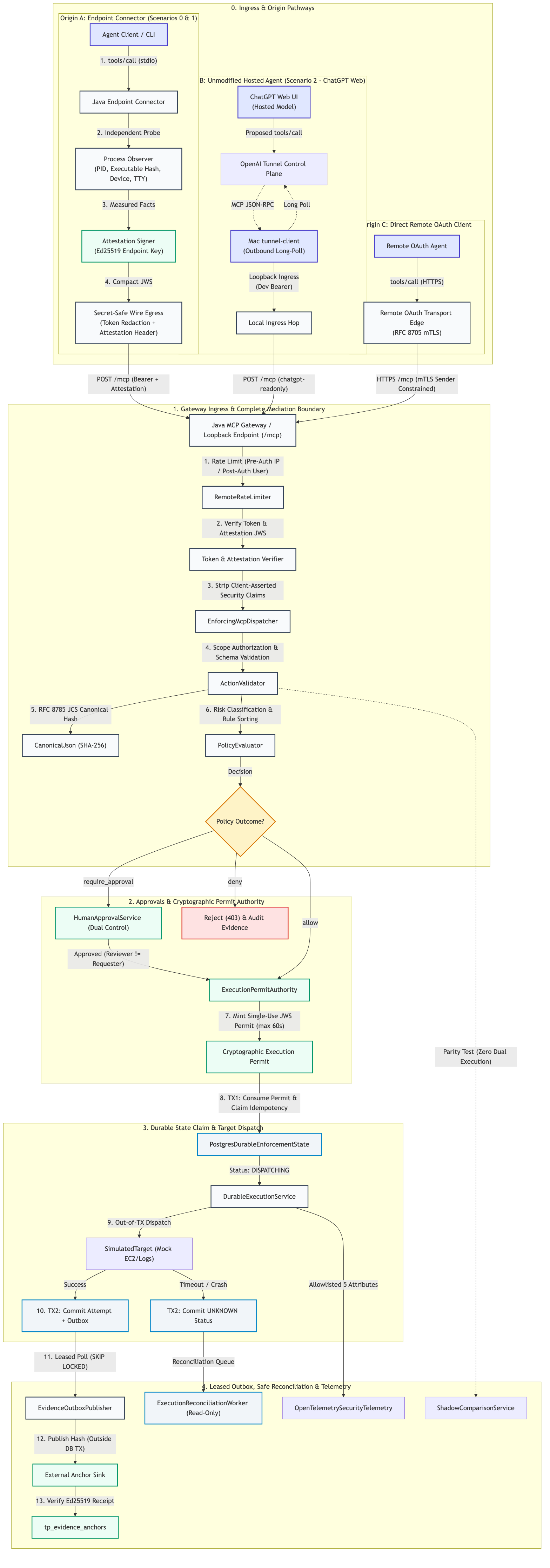
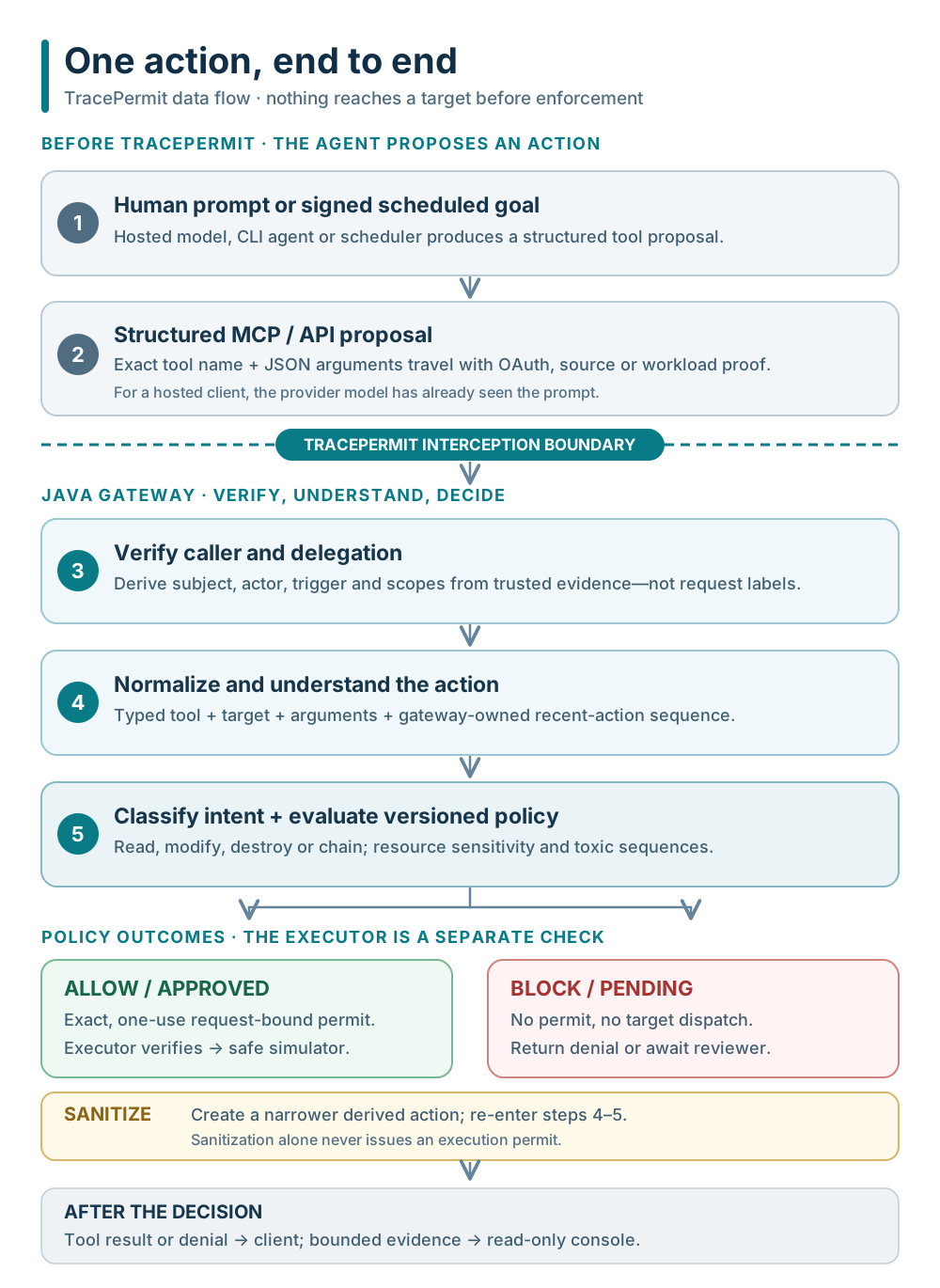
The model sends its proposed tool call through the client/provider integration; TracePermit does not intercept the model's private reasoning before the model service runs. At the controlled MCP boundary, a trusted adapter verifies credentials and derives subject, actor, tenant, trigger, and provenance. Tool arguments cannot declare themselves authenticated or approved.
Data flow and lifecycle stages
Origin-specific attribution
| Origin | Trusted evidence in the POC | Limit |
|---|---|---|
| Local stdio connector | Independently observed process facts, signed proof bound to the MCP request and credential fingerprint | Development enrollment and replay state are not a managed fleet solution |
| Hosted ChatGPT via tunnel | Verified OAuth access token identifies an issuer-qualified human; hosted client is the actor | Qualified for one Auth0/ChatGPT/tunnel simulator composition only |
| Signed scheduled workload | Operator-trusted workload signature and narrowed delegation chain | In-process adapter, not a production scheduler route |
Causal lineage answers what led to a call. Authority delegation answers what a signer authorized the next actor to do. They are never conflated.
Action and execution boundary
The current action contract is contracts/json-schema/intercepted-action-v1.schema.json. tracepermit-canonical-json-v1 defines deterministic serialization for hash-bound proofs; it is not a CloudEvents envelope. The Java gateway classifies the normalized action and its gateway-owned sequence history, evaluates policy, and issues a request-bound permit only for an allowed effective action. A sanitizer creates a distinct derived action and sends it through policy again. Approval is exact-request bound and requires an independent authorized reviewer in the durable profile.
The durable PostgreSQL profile claims permits and records attempts before simulator I/O. When the outcome is uncertain, read-only reconciliation can append a confirmed result; the effect is not blindly retried. This does not guarantee exactly-once effects in an independent real target.
For implementation details and explicit production gaps, read the high-level design and capability matrix.